Is Gunsmith a Good Job? Pros and Cons
See if you qualify for Gunsmith programs
Answer a few questions in 2 minutes. Free, no commitment.
Gunsmithing is a good job for people who like precise mechanical work and want a trade they can eventually run on their own. School programs take about 16 months to two years, and the federal license to open a shop costs $200. The tradeoffs are modest typical pay, few schools, and a business that carries real legal responsibility. Whether it's a good fit depends on how much you enjoy the work itself, so weigh the work as much as the pay.
The Upside of Gunsmith Work
- Hands-on, varied work. One day can include diagnosing a feeding problem, fitting a barrel, refinishing a stock, and mounting optics.
- Training you can finish in under two years. Full-time gunsmithing programs run from about 16 months to two years, and short certificates and NRA summer classes let you start smaller.
- A clear path to self-employment. Once you're 21, a Type 01 federal firearms license costs $200 for three years. Most states don't add a separate gunsmith license; our guide on how to become a gunsmith lists the ones that do.
- More than one kind of employer. Gun shops, ranges, manufacturers, custom builders, and military and police armories all need people who can keep firearms working.
- Skills that keep growing. Specialties such as checkering, engraving, custom rifle building, and pistolsmithing can set your work apart and let you charge for it.
The Downsides
- Typical pay is modest. The federal wage group that includes gunsmiths had a $49,230 median in May 2025, and the lowest-paid 10 percent earned under $36,080.
- Few schools. Only a handful of colleges and private schools teach gunsmithing in person, so many students relocate for training. See where gunsmith training is offered.
- Compliance is part of the job. Running your own shop means federal recordkeeping for guns kept overnight, local zoning rules, and in some states an extra license.
- Tools cost real money. Murray State estimates $1,500 to $2,000 in tools each semester, Colorado School of Trades puts tools and materials at about $5,000, and a shop of your own adds machines on top.
- Legal eligibility is a hard line. Anyone barred from possessing firearms, such as people with felony convictions, can't do this work.
- Self-employment takes time to build. Your income on your own depends on how much work comes through the door, and a reputation takes years to earn.
- Shop hazards. The work involves machine tools, solvents, and metal finishes, so safety habits matter.
Gunsmith Salary by Percentile
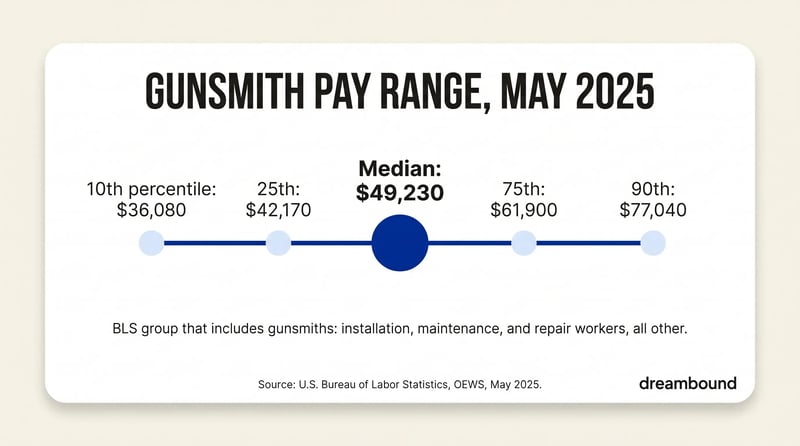
Federal wage data doesn't list gunsmiths separately. The Bureau of Labor Statistics counts them in "installation, maintenance, and repair workers, all other," a mix of repair jobs that employed about 176,300 people in May 2025:
Percentile | Annual wage, May 2025 |
|---|---|
10th | $36,080 |
25th | $42,170 |
Median | $49,230 |
75th | $61,900 |
90th | $77,040 |
Source: BLS Occupational Employment and Wage Statistics.
Treat these as a rough range for employed gunsmiths. Shop owners set their own prices, so what they earn rides on their specialty, local demand, and how many jobs come in.
Are Gunsmiths in Demand?
Steady, but not fast-growing. BLS projects the wage group that includes gunsmiths to grow 2.6 percent from 2025 to 2035, with about 18,300 openings a year across all the jobs in that group, according to its employment projections. Because the group covers many kinds of repair work, those figures say little about gunsmithing on its own. Locally, demand comes down to how many gun owners, shops, and ranges are nearby, and gunsmiths with a specialty, such as custom rifles or older firearms, may face less competition.
Where Gunsmiths Work
- Gun stores and pawn shops with a repair counter, where you'll handle cleaning, repairs, and scope mounting.
- Shooting ranges, keeping rental guns running and sometimes servicing customer firearms.
- Manufacturers and custom shops, doing assembly, fitting, finishing, and quality control.
- The military, which trains its own small arms repairers, such as Army MOS 91F and Marine Corps MOS 2111.
- Police departments, whose armorers maintain duty weapons. Armorer courses from brands such as GLOCK and FN are often restricted to police, military, and dealer staff.
- Your own shop, once you have a federal firearms license and any license your state requires.
Who Gunsmithing Suits
It's likely a good fit if most of these describe you:
- You enjoy taking things apart, figuring out why they fail, and fixing them.
- You're patient with small parts and precise measurements.
- You like learning machine tools, metalwork, and woodwork.
- You're comfortable with paperwork and following federal rules exactly.
- You'd move or commute for training, or you can find a shop willing to teach you.
If that sounds like you, compare how long gunsmith training takes on each route before you choose.